


Transforming Veterinary Medicine
A gift of $120M from the Weill Family Foundation, led by philanthropists Joan and Sanford I. Weill, broadens UC Davis’ vision in advancing animal and human health.

When Joan Weill brought her Bichon Frisé Angel to UC Davis’ small animal hospital in 2018 for treatment related to her lymphoma, she never imagined it would lead to a long-term investment in the university’s school of veterinary medicine. She was just trying to save a beloved family member.
“When I walked into the reception, they didn't know me,” Joan recalled. “Everybody was so caring and kind, and they tried so hard to save her.”
The school is renowned for its translational approach, bringing foundational scientific discoveries and human medicine treatments into clinical practice to improve patient health, diagnosis and treatment. Even though Angel passed away, she was given an improved quality of life in her final months. Joan and her husband Sandy recognized the value of the care she received and the approach that UC Davis was taking. They created the “Angel Fund” in her memory in 2019 to expand the Veterinary Center for Clinical Trials (VCCT), which brings novel treatments to companion animals. They also created the Joan Weill Translational Research Endowment in 2024 to provide ongoing support to the critical and life-changing work of the VCCT.

“The research approach made such an impression on me,” Joan said.
Joan and Sandy have both been engaged as champions and philanthropists in medicine for many years and recognized the opportunity for greater collaboration between veterinary and human medicine.

“What we need is something that speeds the future up dramatically,” said Sandy. “What would take us maybe six or seven years to evaluate in human medicine—with animals that have the same disease characteristics it can possibly happen much faster. And what that can do to the cost of developing new and better drugs and making life better for people and animals is enormous.”
Sandy, who is the former president of American Express and chair and CEO of Citigroup, has been a member of Chancellor Gary S. May’s Board of Advisors since 2014. Through that connection, he and Joan have witnessed the excellence of UC Davis firsthand. When they heard of Dean Mark Stetter’s plans for an expanded Veterinary Medical Complex at the school, they saw a vision that matched the opportunity they had already identified.
“I've watched in the last nine years UC Davis change dramatically in just about everything that it does,” Sandy said. “And I felt this is a really, really great place. Knowing how well the veterinary school has done and how Mark wanted to make this three-quarters of a billion-dollar investment to expand—because you need more room for research, for education and for patients to meet the vision—we thought: this is going to happen. The future is limitless and we have this opportunity.”
By naming our veterinary school in Joan and Sandy’s honor, we celebrate their transformative generosity and lasting commitment to improve the health of all species.”
—Chancellor Gary S. May

A Historic Gift
On January 28, the university announced the largest gift ever made to veterinary medicine worldwide: $120 million from from the Weills through the Weill Family Foundation to support its top-ranked veterinary school.
Eighty million dollars of the gift is helping to build a new small animal hospital, and 40 million dollars is directed toward research.
In recognition of their commitment, the university renamed the school the University of California, Davis, Joan and Sanford I. Weill School of Veterinary Medicine—or simply the UC Davis Weill School of Veterinary Medicine.
Their extraordinary generosity will allow UC Davis to move faster, think bigger and rise to meet the most urgent challenges facing our world.”
—Dean Mark Stetter

“By naming our veterinary school in Joan and Sandy’s honor, we celebrate their transformative generosity and lasting commitment to improve the health of all species,” said May. “UC Davis is world-renowned for excellence in veterinary medicine, research and service. We are deeply grateful for Joan and Sandy’s vision and partnership to help us accelerate the great work taking place here.” The gift will strengthen UC Davis’ leadership in comparative medicine—the study of health and disease across species—and advance translational research initiatives for diseases such as cancer, neurological disorders and cardiovascular conditions that affect both animals and humans.
The funds will also support a reimagined, leading-edge renewal of the veterinary campus including construction of a small animal teaching hospital and expand the school’s capacity to train the next generation of veterinarians. Stetter said the Weills’ support will revolutionize what is possible in veterinary medicine.
“Joan and Sandy Weill’s extraordinary generosity will allow UC Davis to move faster, think bigger and rise to meet the most urgent challenges facing our world,” Stetter said. “This gift empowers us to drive discoveries, expand access to world-class education and develop new insights at the intersection of veterinary and human health. It launches an exciting new era in veterinary medicine and provides the catalyst needed to advance the construction of our new hospital. With continued support from our philanthropic community, we can bring this vision to completion.”
“UC Davis is home to one of the world’s most outstanding veterinary schools and many of the brightest minds in animal and human medicine,” said Sandy. “We are proud to support an institution where groundbreaking research and compassionate care are prioritized together, and where discovery benefits both animal and human health.”
Eighty million dollars of the gift is helping to build a new small animal hospital, and 40 million dollars is directed toward research.
New Small Animal Hospital

Eighty million dollars of the Weills’ gift will help build a new small animal hospital. The current facility, which is already one of the busiest veterinary hospitals in the world, cares for approximately 50,000 patients annually.
Designed to meet the growing demand of clients, educate more students and expand the school’s impact, the state-of-the-art facility will enable:
- Care for up to 20,000 additional animals across an array of specialties
- More cutting-edge research and clinical trials, advancing treatments that benefit both animals and humans
- Integration of artificial intelligence and precision medicine, unlocking new possibilities in diagnostics, treatment planning and patient outcomes.
The Weills’ support will help UC Davis address the shortage of veterinarians by expanding the facilities and infrastructure needed to recruit and train more veterinary students and specialists in high-demand fields such as emergency and critical care, oncology, neurology, cardiology and primary care.
Research Support

Forty million dollars of the Weills’ gift will be dedicated to fundamental and clinical research. The enhanced research funding will accelerate team science, support early-stage discovery projects and enable faculty to pursue high-impact ideas that often fall outside traditional funding sources.
In making the gift, the Weills cited the school’s track record of collaboration with UC Davis Health, UCSF and other academic medical centers to advance translational and comparative discoveries that lead to breakthroughs in care, diagnostics and treatments for animals and people.
For instance, stem cell techniques developed in bulldog puppies with spina bifida helped enable surgeons at UC Davis Health to treat the condition in humans before a child is born, significantly improving lives for dogs and people.
In another recent study, UCSF and UC Davis partnered to develop a clinical trial that benefitted cats with squamous cell carcinoma, opening potential new paths for treatment in humans. With expanded research capacity and facilities, UC Davis will be equipped to pursue similar breakthroughs that directly improve the lives of animals and people.
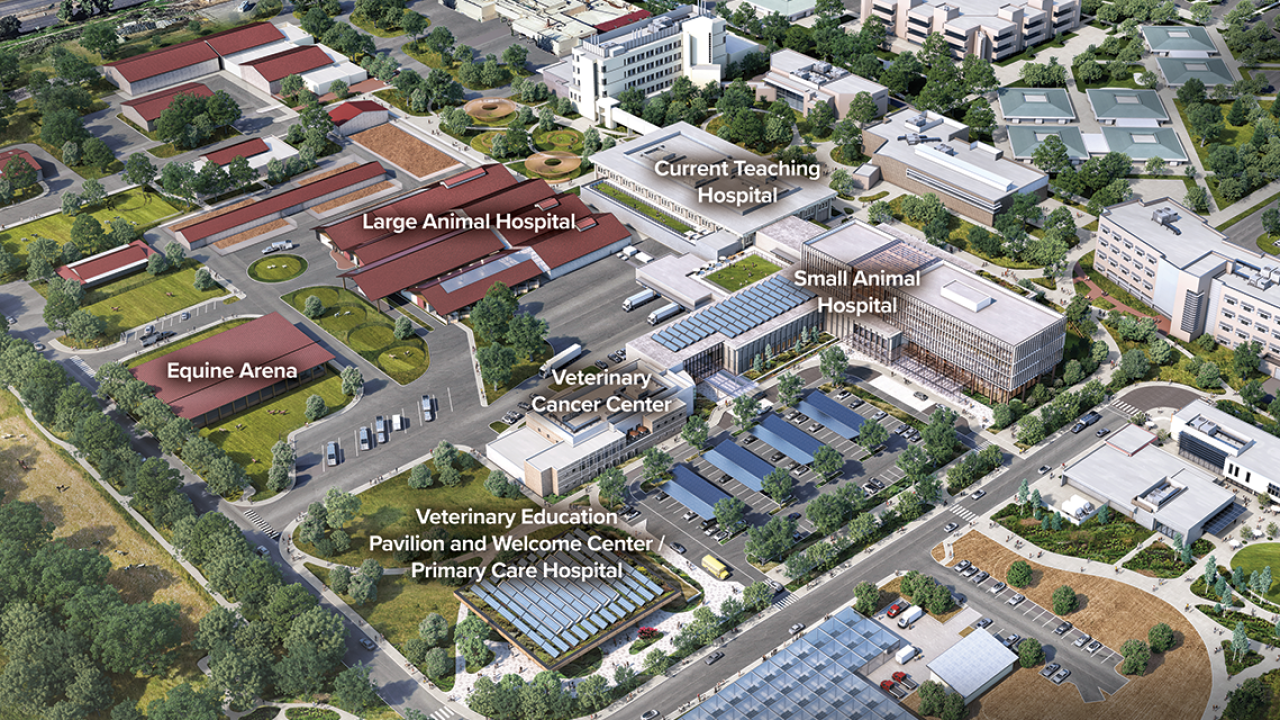
Veterinary Medical Complex

The Weills’ gift, combined with an additional $110.5 million in gifts announced in September, ensures that the school will be expanding rapidly in the coming years. Projects being planned include:
- Small animal hospital
- Veterinary education pavilion and welcome center
- Primary care hospital
- Equine hospital
- Veterinary cancer center
- Spay-neuter clinic
- Raptor education center
If you’d like to support these projects or others planned for the Veterinary Medical Complex, please contact: Sasha Wirth, Executive Director of Development, VMC at (530) 383-1273.