


Discoveries

Common Disinfectants More Toxic When Inhaled
Breathing in common disinfectant chemicals known as quaternary ammonium compounds, or QACs, may be far more harmful than swallowing them, according to a mouse study led by UC Davis researchers. The study, published in Environmental Science and Technology, found significant lung injury at blood QAC exposure levels similar to those measured in humans. It raises questions about whether airborne exposure from disinfectant sprays and cleaning products could contribute to respiratory disease such as asthma or chronic obstructive pulmonary disease.
“The surprising result of this study was that these compounds, when inhaled, caused 100-fold more lung injury and 100-fold more lethality compared to oral ingestion,” said lead author Gino Cortopassi, a biochemist and pharmacologist with the UC Davis Weill School of Veterinary Medicine.
These compounds have been widely used as disinfectants since the 1940s, under trade names Lysol and Roccal. While not very volatile, meaning they don’t make fumes by themselves, they are commonly used in disinfectant sprays, which can enter the lungs. The compounds are also found in some herbicides, eye drop disinfectants, nasal sprays, mouthwash, dryer sheets and fabric softeners.
“We have to question whether we really want to have all of these QAC-based disinfectant sprays in the environment given their proven lung toxicity in mice,” Cortopassi said.
Other authors include Lauren Adcock, Claire B. Montgomery, Sepehr Barkhordari, Sandipan Datta and Laura Van Winkle of UC Davis; Kyoungmi Kim of UC Davis Health; and Ryan Seguin and Libin Xu of the University of Washington.
The study was funded by the National Institutes of Health's National Institute of Environmental Health Sciences.

Could Penguins Help Monitor Ocean Pollution?
New research from the school’s Karen C. Drayer Wildlife Health Center’s Latin America Program and the University at Buffalo shows that Magellanic penguins living along Argentina’s Patagonian coast can serve as living monitors of their environment by using small, chemical-detecting leg bands.
The idea began with inspiration from UC Davis Native American Studies professor Beth Rose Middleton Manning, who uses silicone wristbands to measure environmental toxin exposure in tribal communities. After hearing her talk, Latin America Program director Dr. Marcela Uhart began exploring whether a similar approach could be adapted for wildlife. That led to a collaboration with researchers at the University at Buffalo, who were using silicone bands to study childhood exposure to metals, pesticides, and other neurotoxins. Together, the team adapted the technology for use on penguins.
In a proof-of-concept study, researchers fitted 54 Magellanic penguins in Argentina with silicone leg bands that absorb chemicals from the environment while the birds forage. The minimally invasive sensors allow scientists to detect pollution exposure in marine ecosystems that are otherwise difficult to sample.
This collaborative research is a powerful example of One Health thinking in action: ideas developed to understand environmental health risks in human communities can also help protect wildlife and ocean ecosystems.

Better Understanding Food Safety Risks in California Produce
A major five-year study on California’s Central Coast led by the U.S. Food and Drug Administration and the UC Davis Western Center for Food Safety (WCFS) is helping scientists better understand how harmful bacteria can move through the environment.
Often called the nation’s “salad bowl,” growing more than 400 crops, including a large portion of the country’s leafy greens, the Central Coast has been linked to several foodborne illness outbreaks. In 2020, the FDA asked the WCFS to play a central role in a large-scale environmental study to better understand where disease-causing bacteria come from and how they spread.
Researchers worked in close partnership with the FDA, the California Department of Food and Agriculture, ranchers, landowners and growers.
“This was a five-year collaborative effort to test the environment within and surrounding produce fields, such as soil, surface water, sediment and air,” said Rob Atwill, a principal investigator for the center and an epidemiologist with the UC Davis Weill School of Veterinary Medicine.
Researchers also collected feces from livestock and wildlife at numerous ranches and vineyards to better understand the occurrence of bacteria at those locations.
Kitten’s Brain Surgery Could Transform Care for Human Patients
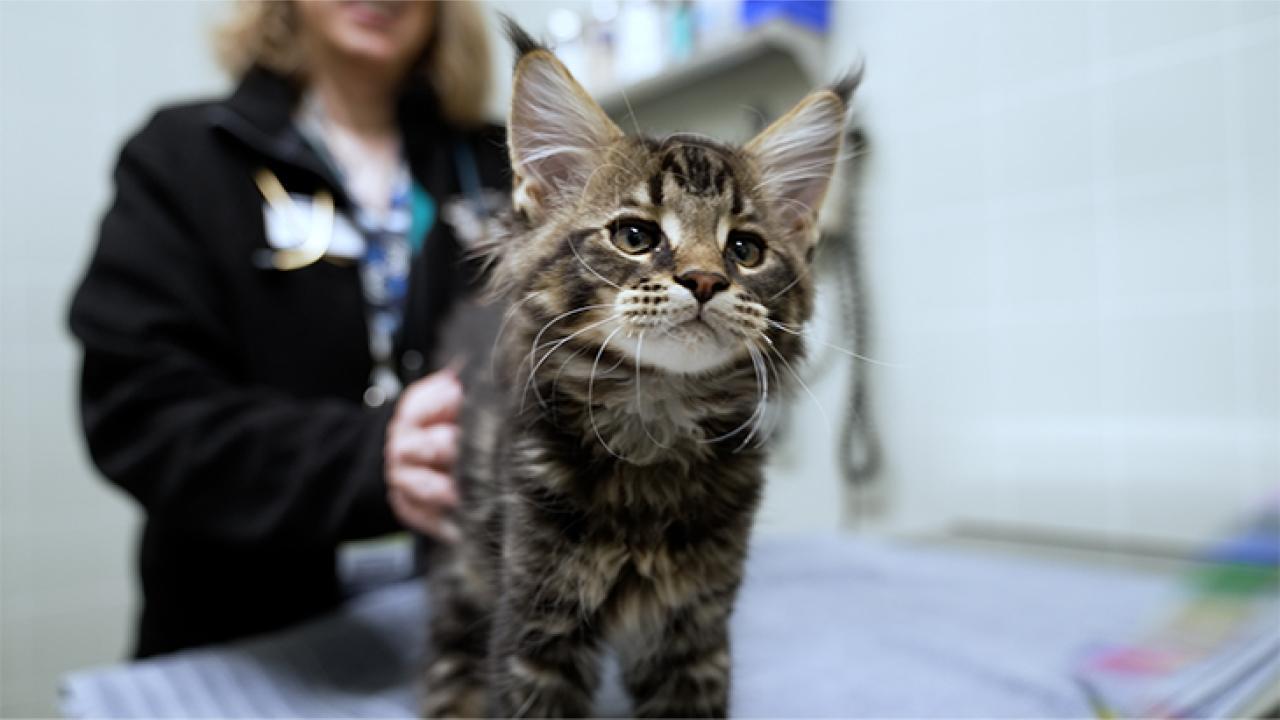
UC Davis’ unique integration of human and animal health expertise has given a fluffy, friendly kitten a chance at survival—and opened the door to ideas that could someday help human patients. Viggo, a Maine Coon, was born with feline hydrocephalus, a buildup of fluid inside the brain that is often fatal.

“These kittens don’t feel well,” said Dr. Karen Vernau, veterinary neurologist at the UC Davis Weill School of Veterinary Medicine.
“They may circle, they can’t stand, and when it really gets terrible, their brain can herniate, and they pass away.”
Treatment options are rare and often fail. Most kittens with hydrocephalus are euthanized within months.
Enter Dr. Cameron Sadegh, a pediatric neurosurgeon at UC Davis Children’s Hospital. He treats the same condition in babies and although the procedure is effective, it hasn’t changed in about 70 years. When he learned about Viggo's case, he saw a rare chance to work with his counterparts in veterinary medicine to save a cherished pet—and shape future treatment for humans.
He developed a novel approach to combine two procedures that would help divert fluid under the scalp and create a natural drainage pathway without shunts, eliminating the need for subsequent surgery as a patient’s brain grows.
On surgery day, Sadegh joined veterinary neurosurgeons Ji-Hey Lim and Adrien Dupanloup at the UC Davis veterinary hospital. With an endoscope, a tiny camera just one millimeter wide, they navigated Viggo’s brain to create a precise opening in the third ventricle. A small tube called a catheter then allowed fluid to disperse under the scalp. “It was amazing,” Sadegh recalled. “We were looking at the fluid spaces in this sort of magical, underwater-type voyage.”
Months later, Viggo returned for an MRI. The images showed what Sadegh hoped to see: less fluid, thicker brain tissue and a catheter still in place. Recovery wasn’t instant, but Viggo is now thriving. Another kitten has already had the same procedure, adding valuable knowledge for future research.
Viggo’s owner, Erin Cooper is grateful that Viggo’s surgery could someday transform care for the smallest and most vulnerable humans.
“Him being a part of helping not only other animals, but humans and babies—it’s amazing.”