


Goats, Guts & Gains
A week in the life of large animal veterinarian, parasitologist, surgeon, and champion weightlifter Dr. Grace VanHoy.

For someone who gets a bit squeamish about blood from herself or other humans, it may seem counterintuitive that Dr. Grace VanHoy became a board-certified internist in large animal medicine with surgical expertise. (If you’ve ever witnessed a bovine c-section, you know it’s not for the faint of heart.)
But that is just one of many facets of her role as an assistant professor of Livestock Medicine and Surgery at the UC Davis Weill School of Veterinary Medicine. She’s also a self-identified nerd with a keen interest in parasitology, a passionate teacher and a world Armlifting champion—a varied skillset that makes her a gifted faculty member and mentor.
VanHoy grew up in Modesto and received her bachelor's degree in animal science from Cal Poly, San Luis Obispo. She earned her DVM in 2015 from The Ohio State University where she also completed an internship and subsequent residency while earning a master’s degree with an emphasis in comparative veterinary medicine and veterinary parasitology. She served on the faculty there for two years before joining UC Davis in 2022.
She didn’t always see herself in academia, however. It wasn’t until her DVM fourth year clinical rotations when VanHoy met some inspiring teachers that she began to consider an academic career path. Dr. Sarah Depenbrock (a former UC Davis faculty member) was finishing her residency at Ohio State during that time and convinced VanHoy to pursue a year-long internship.
That’s where she had her first opportunity to teach veterinary students.
“Turns out, I loved it!” Van Hoy said. “I couldn’t get enough of it; it felt like exactly where I needed to be.”
By the time she completed her residency a few years later, VanHoy was teaching 10 labs and 6-8 hours of lecture. Apparently, veterinary students love her teaching too as she was chosen to be the faculty commencement speaker in 2025 after only 2.5 years of being at Davis. That same year, she was awarded the Faculty Distinguished Teaching Award.
Her nomination stated: “In less than four years here, she has made a significant mark—teaching across all four years of our curriculum, from physical exams in year 1 to complex surgeries in year 4.”
For someone who gets a bit squeamish about blood from herself or other humans, it may seem counterintuitive that Dr. Grace VanHoy became a board-certified internist in large animal medicine with surgical expertise.
For someone who gets a bit squeamish about blood from herself or other humans, it may seem counterintuitive that Dr. Grace VanHoy became a board-certified internist in large animal medicine with surgical expertise. (If you’ve ever witnessed a bovine c-section, you know it’s not for the faint of heart.)
But that is just one of many facets of her role as an assistant professor of Livestock Medicine and Surgery at the UC Davis Weill School of Veterinary Medicine. She’s also a self-identified nerd with a keen interest in parasitology, a passionate teacher and a world Armlifting champion—a varied skillset that makes her a gifted faculty member and mentor.
VanHoy grew up in Modesto and received her bachelor's degree in animal science from Cal Poly, San Luis Obispo. She earned her DVM in 2015 from The Ohio State University where she also completed an internship and subsequent residency while earning a master’s degree with an emphasis in comparative veterinary medicine and veterinary parasitology. She served on the faculty there for two years before joining UC Davis in 2022.
She didn’t always see herself in academia, however. It wasn’t until her DVM fourth year clinical rotations when VanHoy met some inspiring teachers that she began to consider an academic career path. Dr. Sarah Depenbrock (a former UC Davis faculty member) was finishing her residency at Ohio State during that time and convinced VanHoy to pursue a year-long internship.
That’s where she had her first opportunity to teach veterinary students.
“Turns out, I loved it!” Van Hoy said. “I couldn’t get enough of it; it felt like exactly where I needed to be.”
By the time she completed her residency a few years later, VanHoy was teaching 10 labs and 6-8 hours of lecture. Apparently, veterinary students love her teaching too as she was chosen to be the faculty commencement speaker in 2025 after only 2.5 years of being at Davis. That same year, she was awarded the Faculty Distinguished Teaching Award.
Her nomination stated: “In less than four years here, she has made a significant mark—teaching across all four years of our curriculum, from physical exams in year 1 to complex surgeries in year 4.”
Never the Same Day Twice
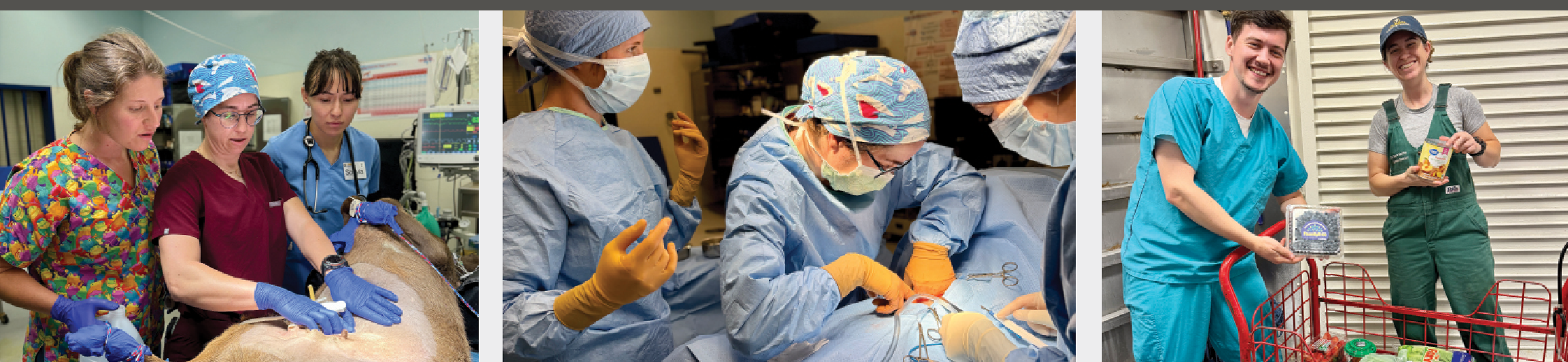
VanHoy says it’s the unpredictability of her days (to some extent) that she thrives on. Sure, there are scheduled appointments for disbudding young goats and surgical rechecks, but then there is a bucking bull brought in with a deep laceration that needs immediate care or a medical mystery in a beloved goat used for backpacking. And if there’s a patient that requires a fecal float to diagnose possible internal parasites, VanHoy is gloved up and at the ready.



I do a lot of interesting, weird things in my job and look at nerdy stuff under a microscope,” she said. “And I get to see a variety of species as well as conduct research and teach. That keeps my job exciting.”
I do a lot of interesting, weird things in my job and look at nerdy stuff under a microscope.”
VanHoy got her surgical experience while at Ohio, an important agriculture producing state in the Midwest with a busy pig season during the dead of winter between January and mid-February. During her residency, she would often have one to two sows a night brought in for c-sections. She estimates she has delivered thousands of piglets; her record delivery is 21 from one pig. One of VanHoy’s favorite surgeries is a tube cystostomy (to treat urinary blockages)—her record time is 35 minutes. She recalled having to do one alone during her internship at 2 am.
During surgeries, VanHoy is often explaining her process and sharing tips to DVM students on clinical rotations or one of the residents. Her surgery playlist is an all-out 90s throwback, including a good dose of Celine Dion, which has made more than one person gowning up in the surgical suite to say, “it feels like we’re at a school dance!”
“I knew taking a job in academia, I’d be able to find a job with a lot of surgeries,” VanHoy said. “The in-house Livestock service faculty team is unique. We’re surgeons in addition to being internists, so all three of us are boarded internists but also surgically trained. We run ICU, surgery, emergencies, and internal medicine in one service overseen by one faculty. It’s challenging, but also provides a lot of experience, volume and repetition—a strong training ground for residents. And they get to see a lot of different types of cases.”
So where does the weight training come into play as a large animal veterinarian?
One night she delivered a 165-pound calf while weighing only 120 pounds herself at the time, and it was her 6th c-section of the night!
VanHoy had been a rock climber for a while when she walked into a gym one day during her residency and got interested in armlifting, a powerlifting sport that is all about grip strength. She soon began competing and fell in love with the weight lifting community and the growth of women in the field.
“As a veterinarian working with sometimes very large and unpredictable animals, having a consistent fitness routine and strength training helps to keep me from getting injured,” VanHoy said. “This is a long career—you gotta prioritize making your body and your mind strong.”
As a veterinarian working with sometimes very large and unpredictable animals, having a consistent fitness routine and strength training helps to keep me from getting injured.”
She’s passionate about mentoring students and other team members working with large animals about how to keep themselves safe and strong. She is careful to point out how to position your body to reduce strain, how to use good body mechanics when restraining and lifting, and how to prioritize planning ahead to move large animals safely.
In addition to her clinical and teaching roles, VanHoy volunteers with the California Veterinary Emergency Team and Covelo Clinic in Mendocino County.
“Thanks to some important role models and my never-ending curiosity, I found a career that blends all the pieces and parts that I love—different challenges both physical and cerebral, problem-solving, and relationship building from the classroom to the clinic. I can’t see myself doing anything else: this is where I’m supposed to be.”